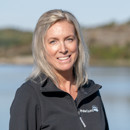

Over the past 40 years, wildlife filmmaker, director and producer Alastair Fothergill has spent a great deal of time exploring and filming the natural world, with a particular connection to the polar regions. Throughout his remarkable career, he has worked closely with Sir David Attenborough on world-renowned series such as Frozen Planet and Our Planet. We are very excited to welcome Alastair as a special lecturer on our Expedition Antarctica 2026. In this interview, he looks back on some memorable moments from his career and shares what you can expect from the journey.
As a guest on this upcoming expedition to Antarctica on Ocean Nova, I think you're in for a very, very special time.
Could you tell us about your work and the role you'll have on board Ocean Nova?
– I'm a wildlife filmmaker and I'm the director of Silverback Films, a wildlife production company based in Bristol in the UK. On Ocean Nova, I'm going to be your special lecturer, giving lectures during the expedition and sharing my passion for the natural world and particularly the polar regions.
Can you tell us about your relationship with the polar regions, and Antarctica in particular?
– Over the last 40 years, I've been very lucky to spend a great deal of time in the polar regions, and in Antarctica in particular. I think I've done over 25 trips to Antarctica, including trips to the South Pole twice, a complete circumnavigation of the continent and many trips to South Georgia.


What first sparked your interest in filming the world's wilderness?
– I first got interested in making wildlife films about the natural world on an expedition to the Okavango swamps in Botswana when I was still at university. The BBC had a competition for amateur expeditions. They gave us a camera and we made, frankly, quite a bad film about the Okavango swamps. But I was totally inspired. I realised this was a way I could spend my life being close to animals and nature.
You worked closely with David Attenborough for many years. Could you tell us a little about that experience?
– Over the last 40 years, I've been very lucky to work very closely with Sir David Attenborough on many series, from Life in the Freezer to Frozen Planet, Blue Planet and Our Planet – many, many productions. It's always been a real privilege working with him. He's very demanding of himself and expects very high standards of all those who work with him, but it's always very exciting. We always know we're doing great work. It's been a wonderful journey together.
What is the most rewarding aspect of your work, and what do you find most challenging?
– I think the two particularly rewarding things about my work – first, of course, is to have the privilege of travelling the world and having close encounters with a wide range of different animals and plants. But also, perhaps almost more importantly, it's the ability to share that through film, through television – to share one's passion, to explain the beauty and the importance of the natural world to a massive global audience.
At the same time, it can be very demanding. Nature has a habit of throwing curveballs. You never know quite what's going to happen. You have to deal with some very difficult physical conditions, but it's absolutely worth it to have so much time in the natural world.


Can you tell us about a particularly memorable experience you've had in the field?
– It's very hard to choose one particularly special or difficult moment while filming in the natural world, but if I was to choose one, it was probably a moment in Svalbard in the High Arctic when I was following polar bears in a tracked vehicle. Suddenly, the first two tracks of the vehicle went through the ice. There was an enormous crack, and we really thought we were about to go to the bottom of the ocean. We had seconds to jump out of the vehicle before it disappeared through a hole in the ice, and we found ourselves with a flare gun out on the sea ice, with a polar bear nearby. Luckily, we had a satellite phone and we could call in some assistance, but that was probably the closest moment I've had in making wildlife films.
What can guests expect if they join this Antarctic expedition with you on board as a guest lecturer?
– As a guest on this upcoming expedition to Antarctica on Ocean Nova, I think you're in for a very, very special time. People who are going south always ask me, “Should I go to the Antarctic Peninsula or should I go to South Georgia?” And the answer is, you should go to both. And on this trip, we will be going to both, and also to the wonderful archipelago of islands that is the Falklands.
But also, it's the perfect time of year. When we head south to the Peninsula, it'll be pristine. It's very early in the season. The penguins are just beginning to breed. The humpback whales are just beginning to arrive from the tropics. And when we reach South Georgia, it's just the perfect time of year. The elephant seals are all there breeding. The males are fighting spectacularly on the beaches. And there are hundreds of thousands of penguins.
It really is a special time to come and we're going to be on a really marvellous ship. I couldn't recommend this trip more highly. And I hope to see you on it.

-
 © Erik Edvardsson
 -
 © Adam Rheborg
 -
 © Johanna Vakkila
 -
 © Erik Edvardsson
 -
 © Erik Edvardsson
 -
 © Erik Edvardsson
 -
 © Erik Edvardsson
 -
 © Adam Rheborg
 -
 © Silverback Films
 -
 © Silverback Films